The highs and lows of a first-time triathlete
Visit our booth on Aug 9th. | 8 am-1 pm | Lake Nokomis | Fun swag & more

Cate Rysavy never thought she was a triathlete. Then she became one.
Cate Rysavy has watched the YWCA Women’s Triathlon roll through her south Minneapolis neighborhood every August for years. Sometimes she’d be out there cheering on friends and neighbors. She knew it was a great event, but she never once considered trying it.
“I never thought I could do something like that,” says Cate.
Then she started working at White Crane.
In 2024, Cate joined the White Crane Design:Build team, where Susan Denk is the founder—and Susan’s passion for the YWCA Women’s Triathlon is legendary.
Susan has raced the triathlon over ten times and inspired many first-timers to give it a try. She sponsors the triathlon through White Crane, and she also sponsors any women at White Crane who want to race. Her belief in women is hard to resist.
Last year, feeling inspired, Cate, who leads White Crane’s Sales and Design team, decided to try it.
“I signed up really not knowing what I was getting into,” she says.
“I didn’t consider myself a triathlete by any means.”
She had the running down. The rest was the challenge.
Cate had been running regularly with a “Moms on the Run” group for years, so that leg of the race didn’t worry her. Over the summer, she rode her bike to her running meetups and felt good about the biking portion.
The swim was the unknown.
To prepare, Cate spent an afternoon out on Lake Nokomis, with her husband paddling alongside in a kayak and her son fishing nearby. Together with her husband, she built a plan: Take the swimming leg of the race slowly and methodically. Use long, steady freestyle strokes, and don’t worry about going fast.
She felt good about her plan. She felt ready.
Until she was standing on the beach.
On the morning of the triathlon, Lake Nokomis was swarming with racers and spectators. Nearly 1,000 women were racing, and the swim portion was kicking off in waves of a hundred at a time.
Cate stood on the beach and felt the nerves hit.

“I kept thinking, what have I done?”
“It was all adrenaline and excitement and nervousness,” she says. “Mostly nervousness, frankly. By the time I got to the water, I was already out of breath.”
And, she was surrounded.
Cate realized immediately that practicing alone on a quiet lake was nothing like swimming inside a churning crowd of bodies.
“Right away I thought, my plan is not going to work here,” she says. She was having a hard time steadying her breath and even putting her face in the water.
“I had to switch my plan,” Cate says. “I thought, ‘I’m going to breaststroke, I’m going to backstroke, just keep my face out of the water, calm my breathing down, and get through this.’ I had to tell myself, I’m going to be okay.”
She knew she was safe. Kayakers along the route had pool noodles for anyone who needed to stop and rest. And she heard Susan’s voice in her mind: “Just keep swimming.”
The swim was hard, and it was long. But she made it through without stopping, and was relieved when that leg was behind her.

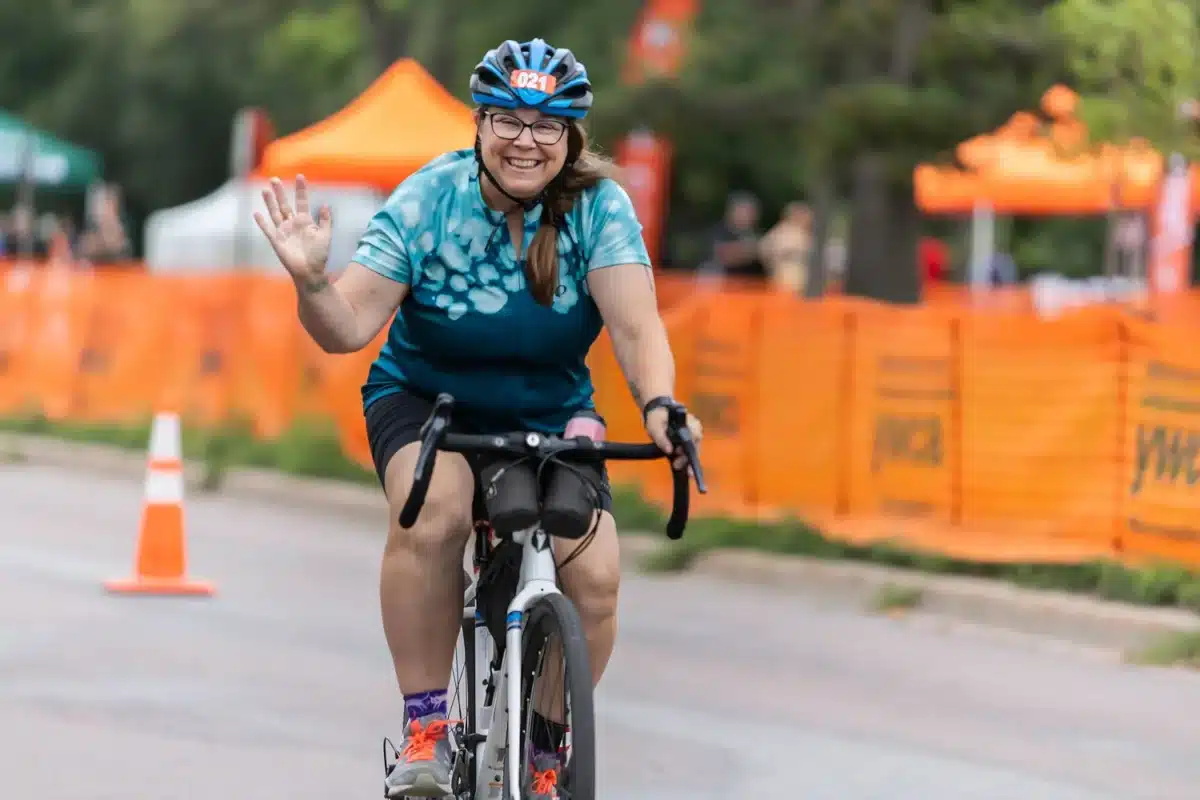
Then everything turned.
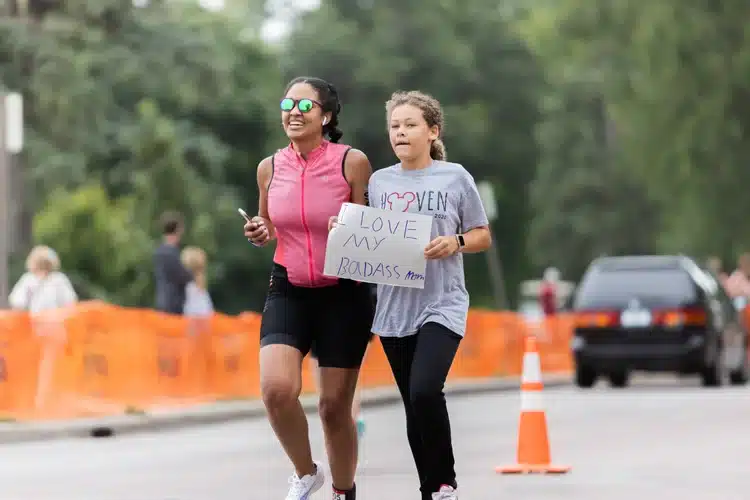
Cate wells up with emotion when she describes what she experienced in the next leg of the race. Once she got past the initial fear of getting started on her bike, the ride opened up and she was able to take in what was going on around her.
“There were volunteers and neighbors and supporters all along the way,” she says, “cheering us on. It was so special,” she says, her voice catching at the memory.
Familiar faces were all around. People she plays pickleball with. Parents from her son’s school. Neighbors.
By the final leg—a 5K run—the exhaustion was real, but the sense of community kept her going.
“This is my home,” she says. “This is the lake I walk and run around all the time, the parkway I’m on every single day. Being at this lake that has so much meaning for me, in this community I love, it was a wonderful experience.”
“It’s a real empowering event, to celebrate women and our strength and what we can do.”
“I feel grateful that I can.”
If you’re going to push through something this challenging, you need a good reason to keep going. For Cate, that reason was simple: “I feel grateful that I can,” she says. “It’s a privilege to appreciate your body and its strength.”
She described seeing her dad and her son out there, cheering her on.
“I’ve seen my son do hard things, and now he saw his mom do something hard,” she says. “I’m raising boys, and it’s wonderful when they can see that moms—and women—are capable and strong.”
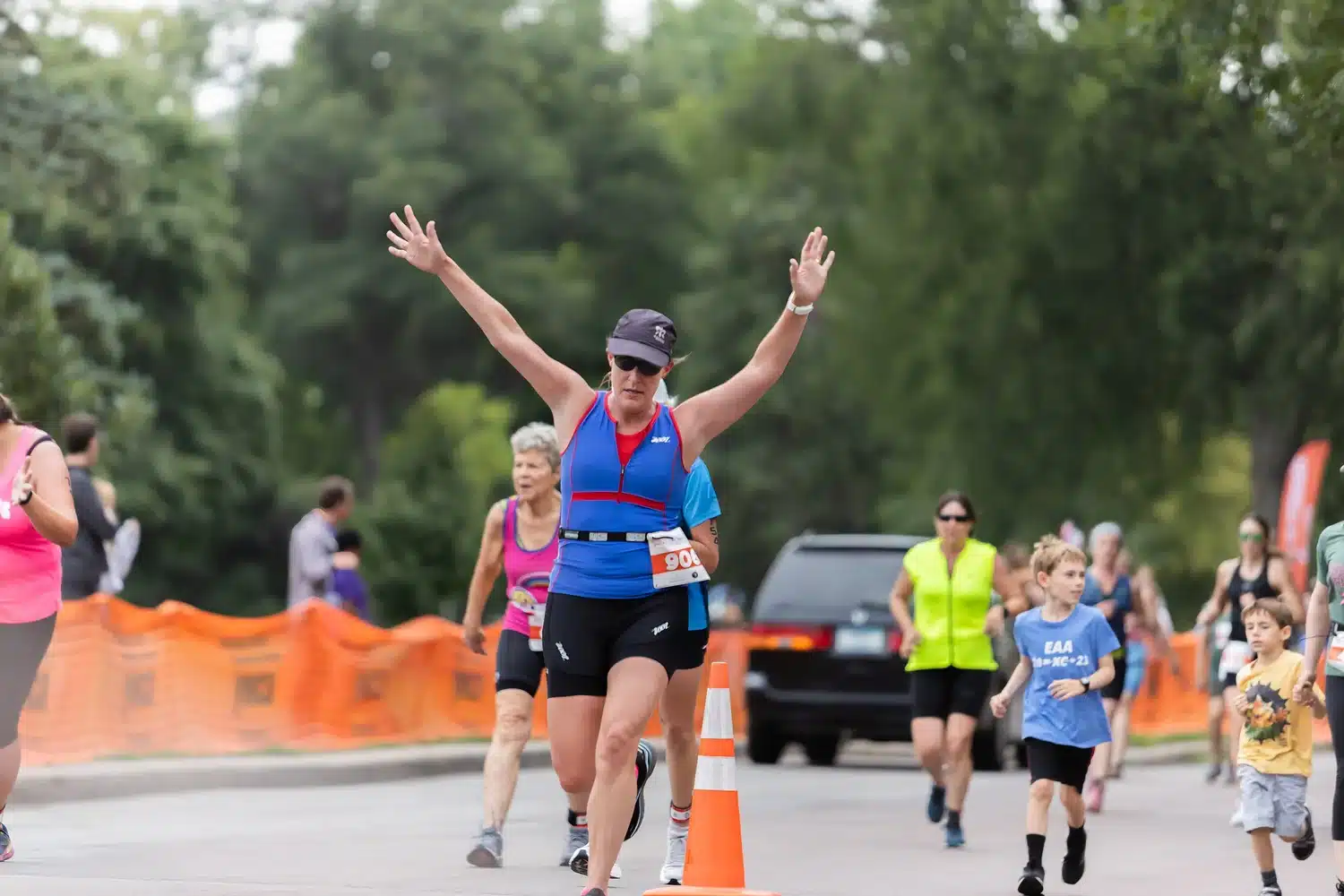
“I felt proud that I could do it. I felt strong. I thought, wow, that was really hard, and yet I got through it.”
Cate’s best advice for anyone standing on that beach for the first time?
“Take deep breaths to calm your nerves—and let the community fuel you,” she says. “Many of the women standing with you on that beach will be first-timers too. And there are so many people out there supporting you, people drumming, people cheering, from all walks of life. It’s really wonderful.”
Cate’s tips for your first triathlon
- Practice swimming in a crowd.
“I should have practiced swimming more, especially in a group. There are a lot of bodies out there, the water’s churning, and you’re trying to figure out where you’re going. Just being in that environment with a bunch of other swimmers entering the water would have been really good preparation that I didn’t do.” (The YWCA runs Tri Social Tuesdays on Lake Nokomis through June and July, so racers can experience a race-like setting.) - Get a tri belt.
“I didn’t even know what a tri belt was. Another person told me about it that morning, and I literally bought one at the booth that day. It makes it easy to clip your bib on and off, rather than trying to mess with pins during transitions.” - Mark your bike.
“There are a thousand bicycles in the transition area, so I put a bright orange towel on top of my bike, and I made a mental note of which tree it was by, so coming off the swim I knew, ‘I’m looking for the orange towel by the tree.’ That was really helpful.” - Lay out your gear in order.
“Have your transition gear lined up in the order you put it on, rather than just a pile. Socks on top of your shoes, then your helmet. Lay it out in the order you’ll do these things, so it’s easy to put on and get on your bike.” - Fuel and hydrate one-handed.
“Staying hydrated and fueled is important. I had a squeeze bottle with electrolytes and a gel packet on my bike. Quick drinks with one hand, rather than messing with tops.” - Train your legs for the switch.
“After you get off your bike, boy, do your legs feel weird. They feel so heavy and strange. Practicing a bike ride and then immediately running a couple of times would help with that.” - Consider a one-piece tri suit.
“I appreciated having a tri suit, so I didn’t have to change anything, and it had the right support for running and biking. I got mine at Gear West, and it was helpful to try it on rather than ordering online.” - Let the crowd carry you.
“There are so many people out there supporting you. It’s so meaningful. Let the community fuel you.”
“Seeing all the other badass women out there, running with their sisters, their daughters, their moms, or just for themselves—it’s a wonderful community experience.”


